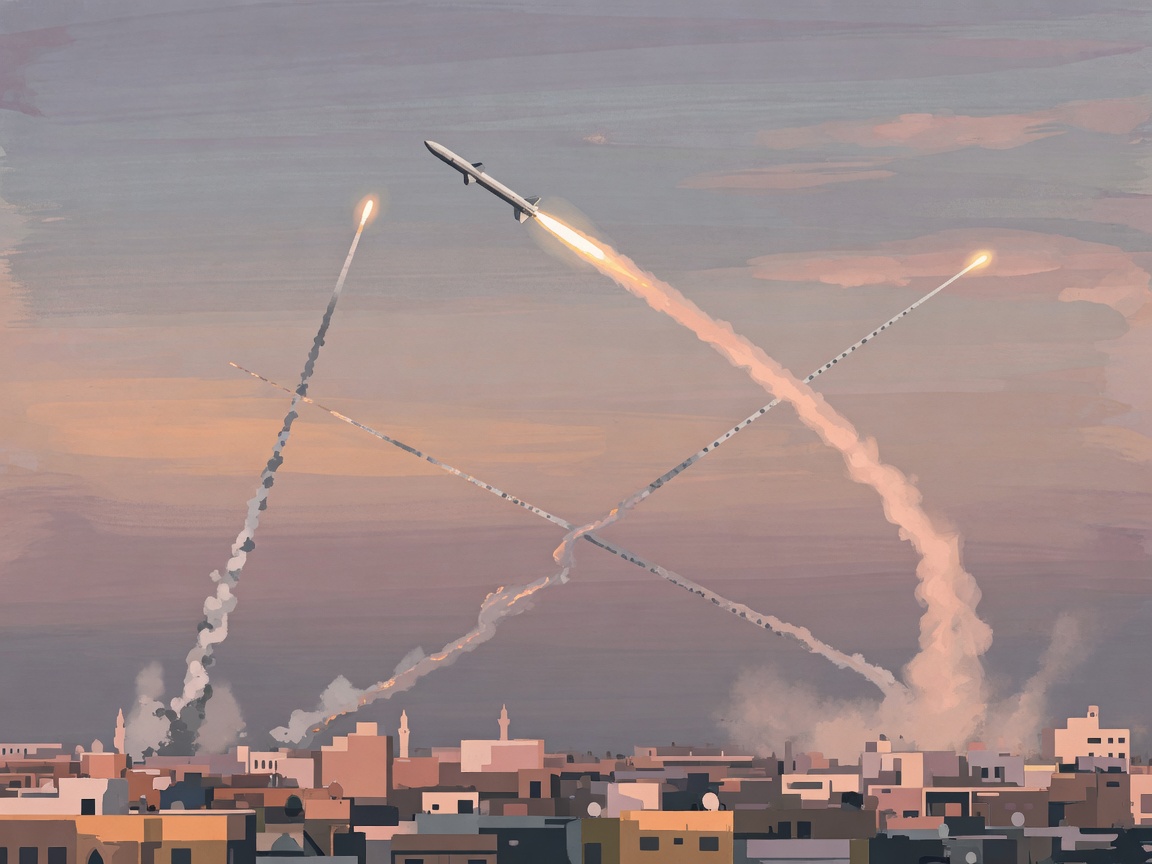
Houthi rebels in Yemen fired a ballistic missile at Riyadh on Saturday, the first attack on the Saudi capital since an escalation in fighting began in July. Saudi-led coalition forces said air defences intercepted and destroyed the missile. No casualties were reported. The strike widens a conflict that has drawn condemnation from the United Nations and regional powers, even as Turkey signaled it could provide military support to Saudi Arabia under a recently signed defense pact.
Air raid alerts sounded across Riyadh overnight on Friday, and at least one explosion was heard in the city on Saturday morning. Residents near King Khalid International Airport reported seeing a large plume of black smoke. Flights at the airport were disrupted temporarily, with the tracking website FlightRadar24 showing delays and cancellations. Saudi Civil Defence had sent phone alerts warning of potential danger before issuing an all-clear on Saturday morning.
One resident of northern Riyadh, a 27-year-old who spoke to AFP on condition of anonymity, described hearing the alarm and feeling windows shake. “It was definitely scary,” the resident said. “I was not expecting this.” An AFP journalist reported seeing firefighters attempting to extinguish flames from a burnt-out fuel tank belonging to Aramco near the airport.
Targets beyond the capital
The Houthis said they used a large number of ballistic and cruise missiles as well as drones to attack what they called sensitive sites in Riyadh. They also targeted Aramco oil and gas facilities in Yanbu, a Red Sea coastal city where a key Saudi pipeline ends. Houthi military spokesman Yahya Saree said the attacks were in response to what he called Saudi attempts to target the Yemeni capital Sanaa, which the Houthis control. Saree had earlier accused Saudi Arabia of carrying out 300 strikes across Yemen during the past week.
Saudi air defences also stopped what coalition spokesperson Major-General Turki al-Maliki described as hostile attempts to target civilians in the cities of Bisha, Taif, Farasan, and Yanbu. The Houthis claimed, without providing evidence, that they had caused massive fires at the Aramco facilities. Aramco, the world’s largest oil company, did not respond to a request for comment from NPR. Saudi authorities did not confirm any strikes beyond the intercepted missile aimed at Riyadh.
Ground fighting and displacement
On the ground in Yemen, fighting between the Houthis and Saudi-backed government forces continued across multiple fronts. According to an unconfirmed AFP report citing military sources on both sides, 48 people were killed on Saturday, with the Houthis saying 31 of their fighters died and government sources reporting 17 soldiers killed. The Saudi-backed government’s armed forces said they thwarted a Houthi infiltration attempt in southern Marib, killing 12 Houthi fighters, and reported that 13 Yemeni soldiers were killed in two days of clashes in the southwestern provinces of Taiz and Lahj.
The International Organization for Migration, a UN body, reported on Friday that the number of people displaced by recent fighting had passed 104,796. Renewed clashes are taking place in Marib, Taiz, Lahj, al-Jawf, and al-Bayda as part of a military escalation that began in early July, described as the most intense since the relative calm following an April 2022 truce.
The Houthis recently seized control of the strategic port city of Mokha and Perim Island, a gateway to a key shipping route. Saudi vessels have relied on that stretch of the Red Sea for oil exports since the war between the United States, Israel, and Iran severely disrupted traffic through the Strait of Hormuz, BBC News reported. The group said its naval blockade was in retaliation for a Saudi blockade of ports and airports in Houthi-controlled northwestern Yemen.
Regional responses and diplomatic channels
Turkey signaled a willingness to provide military support to Saudi Arabia. Turkish Foreign Minister Hakan Fidan told broadcaster NTV that Turkey would “face no difficulty in meeting” any military needs under a recently signed defense pact that also includes Pakistan. “We observe very serious attacks on Saudi Arabia’s territorial integrity and sovereignty,” Fidan said. “We have an alliance agreement in place and we stand by our word.”
Jordan’s Foreign Ministry called the attacks a blatant violation, with ministry spokesperson Fouad Majali saying Jordan stood in absolute solidarity with Saudi Arabia. UN Secretary-General Antonio Guterres and GCC Secretary-General Jassim al-Budaiwi, speaking on the sidelines of the UN General Assembly in New York, condemned the targeting of civilian objects and the threat to regional security. The US State Department urged Americans in the Middle East to exercise vigilance and said the conflict could escalate rapidly.
Separately, Iran’s top security official, Mohsen Rezaei, told Al Jazeera that Tehran had conveyed its conditions for ending the war to the White House through Qatari mediators. Rezaei said the demands include an end to the war on all fronts, the release of frozen Iranian assets, and the lifting of the US naval blockade on Iranian ports. He also said Iran wants the fighting involving Yemen and Saudi Arabia to end. It was not clear when the conditions were shared. The White House had not publicly responded.