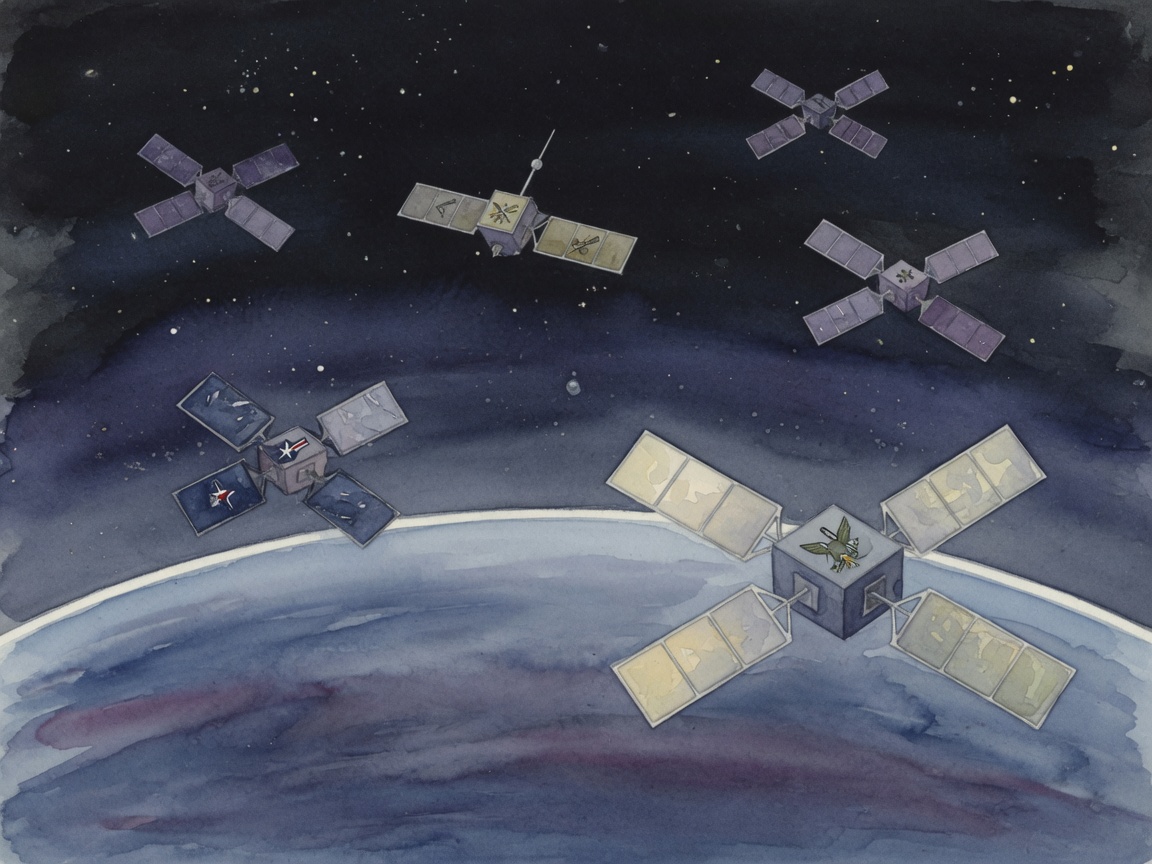
The United States has for the first time publicly confirmed that it has deployed weapons in Earth’s orbit, an acknowledgment that analysts warn will accelerate a high-risk arms race with Russia and China in space.
Air Force Secretary Troy Meink, who oversees both the Air Force and the Space Force, told the annual Air, Space, Cyber conference on Monday that Washington now has “on-orbit, space-control weapons.” He did not specify what the weapons are, what they do, or how many have been deployed.
The disclosure matters. It marks the first official acknowledgment by any US government official that the country maintains weaponry circling the globe, according to space security experts. A Space Force spokesperson said space control could refer to “employing kinetic [combat] and non-kinetic means to affect adversary capabilities,” adding that “these capabilities can be employed for offensive and defensive purposes.”
A deliberate silence on specifics
Meink’s phrasing was intentional. The language was described as “very well thought out,” though the Air Force did not respond to TechCrunch’s request for comment on what threats prompted the deployment. Juliana Suess, a space security expert at the German Institute of International and Security Affairs, told CNBC that the weapon could range from reversible interference such as jamming to kinetic, permanently destructive effects. “This could be anything,” she said. “The only thing that we know is that it is based in space, so this is not a sort of missile based on Earth that could hit a satellite in orbit.”
Dr Bleddyn Bowen, an associate fellow at the Royal United Services Institute and an associate professor in astropolitics at Durham University, told the BBC he could only hazard a guess. He said he would expect “some kind of electronic warfare or radio-jamming platform,” which would be a non-destructive form of anti-satellite weapon. “If you take out the radio links then your satellite is very useless,” he told BBC Radio 4’s Today programme. Bowen did not rule out riskier options. He said a kinetic kill vehicle that releases a projectile to ram into and destroy a satellite was less likely, as was a close inspection and grappling satellite.
Rivals respond
China’s foreign ministry said Washington was “preparing for war in outer space” and warned against turning space “into a battlefield, as well as an arms race there.” In Moscow, Kremlin spokesperson Dmitry Peskov told reporters that Russia believed “that space must be free of any weapon” and called for “the complete demilitarisation of space.” The astronomer Jonathan McDowell, who spent decades compiling rocket launch records and worked at the Harvard-Smithsonian Center for Astrophysics until retiring this year, told the Guardian that Russia and China would now “respond in kind” and deploy their own weapons.
“In the long run, I find it questionable whether this is in the US national interest, and for sure we will see comparable systems from China, if they don’t already have them,” he said. Victoria Samson, the Secure World Foundation’s chief director of space security and stability, told the Defence One website that the US now had to accept that the Chinese and Russians would do the same. “Well, that’s huge, because I don’t think any US government official has ever said that before,” she said.
Samson separately told CNBC that the acknowledgment was “a very destabilizing statement by the United States.” She said it was possible the disclosure was meant as a deterrent and to solidify the Space Force as a warfighting branch rather than one that supports other branches. Russia and China have already been active. In the last 10 years, both countries have conducted rendezvous and proximity operations, described by Dr Rod Thornton of King’s College London as “buzzing” Western satellites. He said such satellites could theoretically become hunter-killers by physically colliding with targets or nudging them out of orbit.
Thornton said Russia compensates for its fewer satellites with missile capability, including ground-based missiles that can strike satellites in low Earth orbit and anti-satellite missiles launched from aircraft. He warned that as a last resort, Russia could launch nuclear weapons into space, and that the electromagnetic pulse blast would “fry” any unhardened satellites over a wide area. The US Space Force says Russia is currently developing a satellite “designed to carry a nuclear weapon,” and China is long suspected of operating spacecraft capable of damaging other satellites. Bowen told the BBC that China has demonstrated “space tug capability,” in which a vehicle can grapple a satellite and move it into a different orbit.
The 1967 Outer Space Treaty banned weapons of mass destruction in orbit but did not prohibit placing conventional weapons there. Russia drew international criticism in 2021 when it destroyed one of its own defunct satellites with a ground-based anti-satellite missile, creating thousands of pieces of orbital debris. McDowell told the Guardian that the US now treats conflict in space as conceptually normalised, a shift from 20 years ago when the stated position was that the country would never want to do that. He urged the US to work mainly with China, calling them the real competitors in space now, and said he hoped the US establishment would reconsider its approach.
Meink, in his address, described a rapidly accelerating threat environment and said adversaries were exploiting new technologies. He said the US would “dramatically increase our combat power by adding large numbers of highly autonomous systems,” and projected “a radically different-looking Air Force by 2032.”