NASA launches $4.3 billion Roman space telescope to map the universe and probe dark energy
The Nancy Grace Roman Space Telescope blasted off from Florida aboard a SpaceX Falcon Heavy, beginning a mission to survey billions of galaxies and hunt for tens of thousands of worlds beyond our solar system.
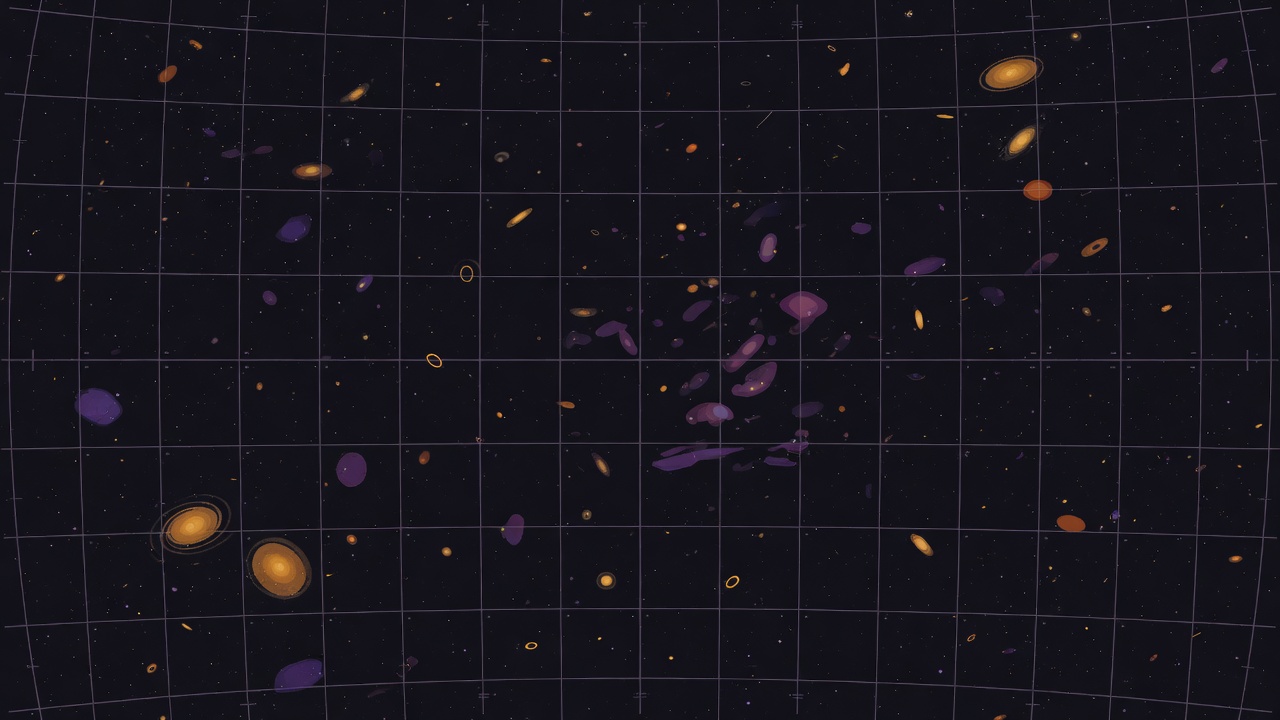
NASA has successfully launched the $4.3 billion Nancy Grace Roman Space Telescope from the Kennedy Space Center in Florida, sending the observatory on a mission to investigate dark energy, dark matter, and planets beyond our solar system. A SpaceX Falcon Heavy rocket carried the bus-sized telescope into space just after dawn on Sunday. The voyage will take more than three months. Roman will reach a destination roughly one million miles from Earth, where it will join the James Webb Space Telescope in orbit around the sun at a vantage point called Lagrange Point 2. The launch gives astronomers a tool with a field of view 100 times wider than Hubble’s, capable of surveying the sky 1,000 times faster using its 300-megapixel infrared camera.
About 30 minutes after liftoff, Roman separated cleanly from the rocket’s upper stage, drawing applause from ground control. The twin side boosters plunged back through the atmosphere and touched down at Cape Canaveral with sharp sonic booms. Nicky Fox, chief of NASA’s Science Mission Directorate, was in tears. “It’s such a good day,” she said.
Roman will operate four times farther from Earth than the Moon, a distance that keeps infrared light from the Moon and Earth from interfering with its cameras, according to astronomer Jenifer Millard. The mission has a five-year primary lifespan. NASA says the telescope may carry enough fuel for five additional years and is designed to be refueled if a robotic tanker becomes available. The telescope launched nearly a year ahead of schedule and within budget.
A wider lens on the cosmos
Roman’s main survey, set to take more than a year, will cover more than two billion galaxies. Its catalogue will help scientists determine how quickly the universe is expanding under the influence of dark energy. “It’s going to find thousands of supernovae, tens of thousands of planets, billions of galaxies and tens of billions of stars,” Fox said. “It’s going to be able to do things that we’ve never been able to do before with its massive field of view.”
Roman also carries a Coronagraph system that can block and mask glare from stars, allowing it to directly image exoplanets, including smaller, older, and colder planets orbiting close to their stars. Fox said the telescope will discover tens of thousands, maybe even 100,000 new exoplanets, providing the first statistical census of planetary systems similar to our own. “Why do we care so much about exoplanets? Because one of our main goals at Nasa is answering the question, ‘Are we alone in the universe’?” she added. “With Roman, we are going to make this giant leap forward... that is going to allow us to look at these distant, distant worlds and start to really resolve the atmosphere around them to let us know: could they be habitable?”
Dark matter, dark energy, and a namesake’s legacy
Dark matter and dark energy together are thought to make up about 95 percent of the universe, yet remain invisible. Ordinary matter, the familiar stuff of stars, planets, gas, and dust, represents only about 5 percent. Dark matter, known through its gravitational influence on galaxies, may account for about 27 percent. Dark energy, believed to be a repulsive force driving the universe’s expansion, may represent about 68 percent. Roman will conduct detailed 3D scans and gravitational lensing measurements to map the distribution of dark matter and study how dark energy shaped the evolution of the universe.
The telescope is named after Nancy Grace Roman, who was NASA’s first chief astronomer in the 1960s and its first female executive. She was instrumental in getting the Hubble Space Telescope approved by Congress. She later said its most interesting discovery was dark energy. Retired NASA scientist Ed Weiler, who coined the phrase “Mother of Hubble” for Roman, said the honor is long overdue. “This is very, very fitting.” “I think Nancy would be very proud,” he said. Roman died in 2018 at age 93.
President Donald Trump dialed in to the agency’s news conference to congratulate the scientists. “You’re the hottest in space, and we have the hottest country anywhere in the world,” he said. Jackie Townsend, a project manager on the Roman telescope, described the launch as glorious. “The ride was magnificent.” “It put us right where we wanted to be,” she said.
Fox said in a press release that “Roman will be a discovery machine that will bring us closer than ever before to answering humanity’s most profound questions about our cosmic history.” Millard said scientists are hoping to create enormous cosmic maps of the universe at various stages through the work of telescopes like Roman. “They’ll be almost like an onion, so you can peel back layer upon layer,” she said. “What we want to do is use this distribution to try and figure out dark matter and dark energy because we know they exist, we see their effects, but what they are is a real mystery.”
Sources & methods
- BBC News report on the Roman telescope launch, including quotes from NASA officials Nicky Fox and Jackie Townsend, astronomer Jenifer Millard, and President Donald Trump Archived Aug 30, 2026
- Al Jazeera report detailing the $4.3 billion cost, Falcon Heavy launch, dark matter and dark energy composition figures, quotes from Nicky Fox and Ed Weiler, and the ahead-of-schedule launch Archived Aug 30, 2026
- The Verge report on the 300-megapixel infrared camera, 1,000-times-faster survey speed, Coronagraph system, 3D dark matter scans, and Nicky Fox's 'discovery machine' statement Archived Aug 30, 2026
This article was assembled from three published news reports on the Roman Space Telescope launch. Direct quotes were verified against the source texts and attributed to the speakers named in those reports.